
The reporting gap has a price. Here is how to work it out

Every lender knows the bureau file is out of date. Very few have put a number on what that costs them.
The Reporting Gap is the time between a consumer taking on new credit and that credit appearing on the bureau file lenders rely on. It is not a rounding error. It reaches up to 55 days, and is a structural risk to the industry.
That delay is easy to account for. Most lenders report to the bureaus on a monthly cycle, so a new loan can sit for up to 30 days before it is even submitted, let’s use 15 days as a fair midpoint. When a file is reported it enters a correction loop that adds another 10 to 20 days. Then the bureau needs time to ingest and publish, which adds 10 to 20 more. Add those up and a loan taken out today routinely takes six or seven weeks to become visible to the next lender.
That window is where the risk hides. It is where:
- A borrower takes out three loans in a fortnight and each lender sees only their own.
- A first payment default is quietly being set up, invisible to everyone lending into it.
- Circumstances change before the file catches up.
Consumers feel it too. Nearly a third of people who check their credit file find an error on it, and slow reporting is a large part of why.
Here is the part most lenders know exists but have not been able to quantify to date. The cost of that gap can be estimated, and the method is simple.
Start with the loan book. Take the annual credit losses on it. Then take the share of those losses that better visibility would have prevented. Credit risk managers consistently put that share at 18 to 30%.
The value of closing the gap is then a function of one thing. How quickly you can see new credit information. Infact enables faster visibility:
- Partner lenders have free access to our Delta platform that identifies data quality errors prior to reporting.
- Same day ingestion of accurate records reported into our bureau - this accounts for roughly 45% of the value inside of the reporting gap.
- Working to migrate lenders to reporting new accounts in real-time via our Reporting API.
Work it through on an illustrative lender. A £2bn personal loan book, with annual credit losses of around £90m. Applying the 18 to 30% range, somewhere between £16m and £27m of those losses each year trace back to decisions made on stale data. That is the price of the gap, before you even count the capital tied up in provisions held against it.
The faster the visibility, the more of that £16m to £27m you recover.
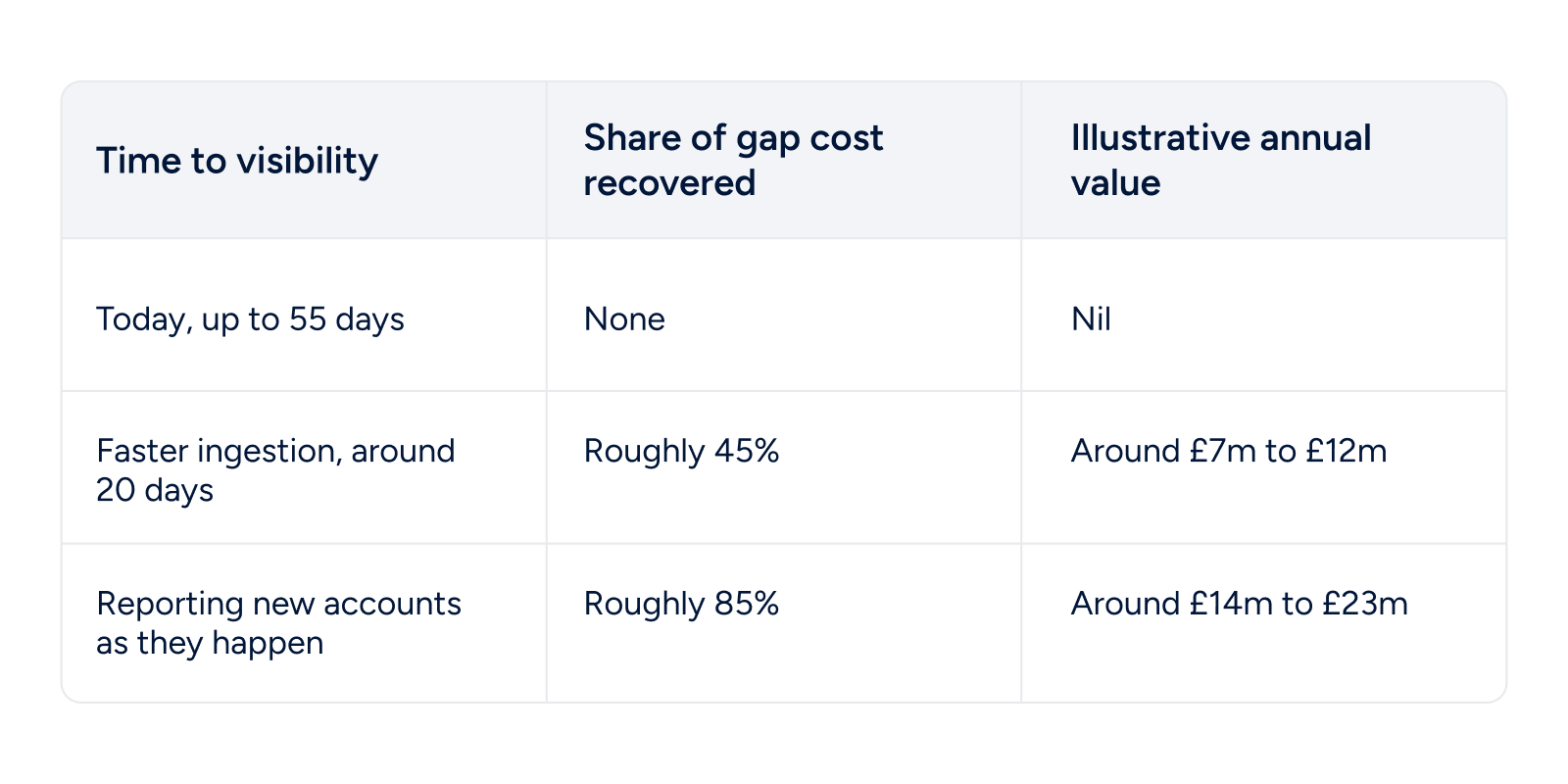
The numbers are illustrative, but the shape holds for any book. Even without moving to real-time reporting, simply feeding a faster network and ingesting within days rather than weeks recovers a meaningful share. Every reduction in time to visibility recovers a slice of the loss.
This is the point worth sitting with. The reporting gap is a data problem, not a model problem. A sharper scorecard cannot see a loan that has not been reported yet. No amount of model tuning recovers information that is not in the file. The only fix is fresher data, and the value of fresher data can be sized before you commit to anything.
That is the honest way to have the conversation. Not with a headline multiplier, but with your own loan book, your own losses, and a defensible estimate of what the gap is costing you. We will run that analysis on your book at no cost and show you the number.
Other articles you may be interested in

Fluro and Infact partner to open up fair access to credit for more UK borrowers

Bureau Meets Mobile Intelligence: A Modular Identity API for Fintech Onboarding

Spot data anomalies with Delta’s month-on-month file comparison

Zopa Bank and Infact partner to improve credit report accuracy

Infact joins the Consumer Credit Trade Association


.svg)
.svg)


%201.svg)


